
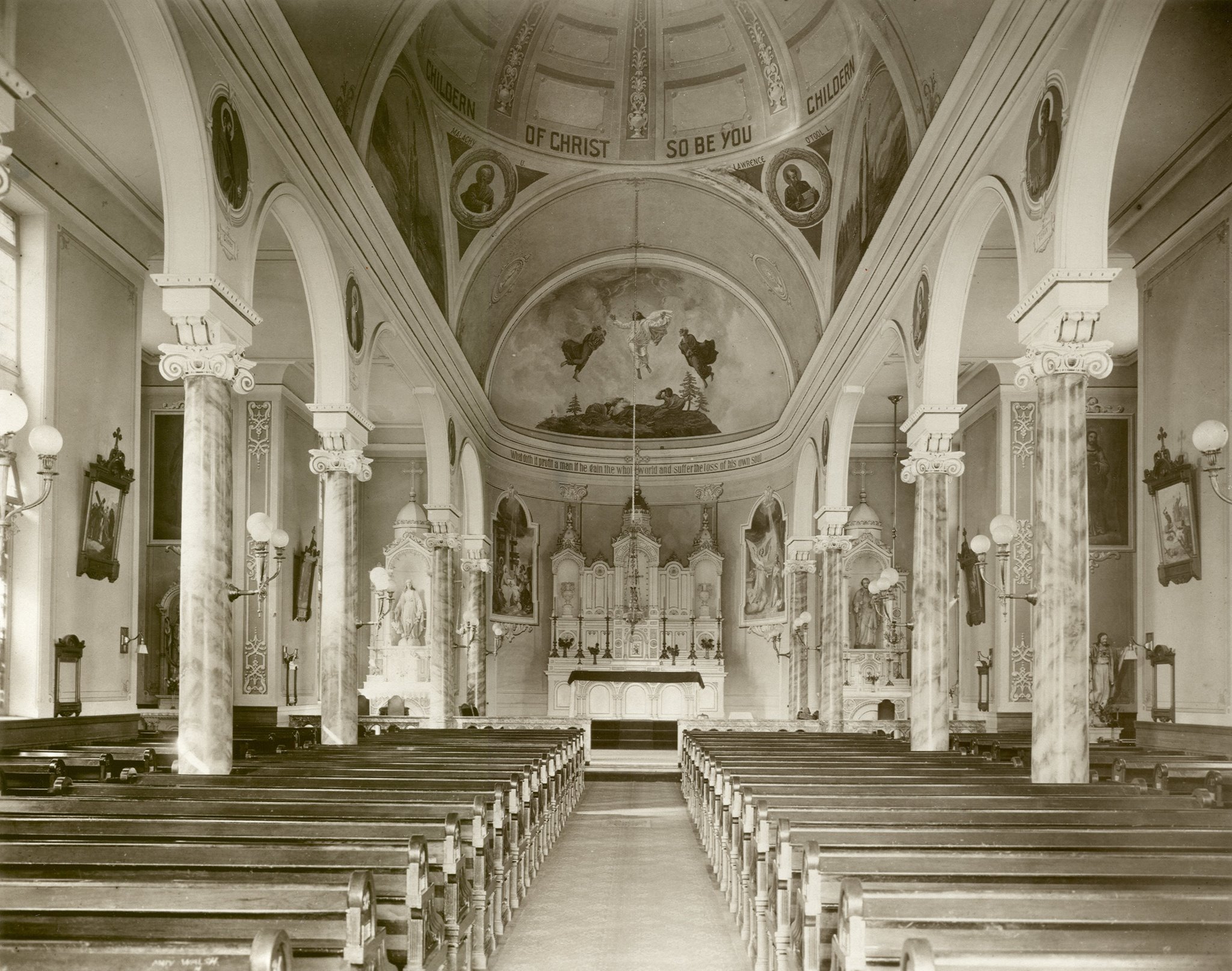
St. Patrick’s is the oldest Catholic church in greater Portland. The cornerstone was laid on St. Patrick’s Day in 1889, and the church was dedicated two years later, in 1891.
“To the glory of God in honor of Ireland’s Apostle, St. Patrick.”Dedication · 1891
Built in 1889 at the corner of NW 19th Avenue and NW Raleigh Street, St. Patrick’s stands just beneath the Fremont Bridge at the edge of the Pearl District in northwest Portland — a home for Catholic worship in this city for well over a century.
A Mission in Slabtown (1885–1889)
Our story begins before the church itself. In 1885, Archbishop William Gross saw that the families of Northwest Portland — lumber-mill hands, dockworkers, and railroad men, many of them Irish immigrants — needed a parish of their own. A modest two-room building rose at 1930 NW Savier Street to serve as both church and school. Dedicated to the Sacred Heart and served as a mission of the downtown Cathedral, it opened with about forty children in its school, taught by the Sisters of the Holy Names of Jesus and Mary; within a few years enrollment had grown to 130.
In 1887 Archbishop Gross purchased the adjoining lots from the Glisan family for $4,000, and asked Father Patrick Gibney — then chaplain of St. Vincent’s Hospital, born in County Meath, Ireland, and trained at All Hallows College and Louvain — to build the new church. Fr. Gibney agreed, on one condition: that the parish be renamed for Ireland’s patron saint. In 1888 he was appointed the first pastor of St. Patrick’s.
The Cornerstone in the Rain (1889–1891)
On St. Patrick’s Day 1889, more than 5,000 Portlanders — many of whom had marched in procession from the Cathedral at SW 3rd and Stark through muddy streets — stood in the rain as a 500-pound basalt cornerstone, quarried in Clackamas County, was hoisted into place at NW 19th and Savier. Governor Sylvester Pennoyer arrived in a carriage with Archbishop Gross, who called out to the drenched crowd: “When St. Patrick’s Day rolls around again, let it rain as it pleases. We will gather you inside that church, the first in Portland to be named in honor of Ireland’s patron saint.”
The church was designed by Otto Kleemann in the Second Renaissance Revival style — today it is the only remaining Kleemann church in Portland. His plans called for brick, but with the foundation already laid the material was changed to Clackamas basalt. Two years later, on March 17, 1891, the still-unfinished church was dedicated “to the glory of God in honor of Ireland’s Apostle, St. Patrick,” with a pontifical high Mass, the Ancient Order of Hibernians, the Marquam Silver Cornet Band, and — after the liturgy — a medley of Irish tunes. Inside, the rough stone walls stood entirely bare: the nation was in recession, and the parish had emptied its purse to raise the walls.
Finishing the Church (1891–1918)
The early decades saw pastors come and go — among them Fr. Edward J. O’Dea, who left St. Patrick’s in 1896 upon his consecration as Bishop of Nesqually, the diocese that became Seattle; and Fr. Edward Donnelly, a gifted designer under whom the interior finally received its lath and plaster in 1899. It was Fr. E. P. Murphy, in his long second pastorate (1904–1918), who brought the interior to glory for the parish’s Silver Jubilee of 1914: new altars and pews, a remodeled sanctuary, and $10,000 of decoration by the Swiss artist Philipp Staehli, who had studied in Rome. Copying images from Trinity College, Dublin, Staehli painted the great fresco of the Transfiguration above the altar, flanked by St. Patrick and St. Brigid, with thirteen saints of Ireland along the nave. The stained glass — some of the earliest work of Portland’s celebrated Povey Brothers studio — filled the church with light. Even amid its own deficits, the parish helped the small band of Irish immigrants founding St. Andrew’s parish across the river in 1907.
School Days and the Immigrant Parish (1918–1944)
Fr. Charles M. Smith (1918–1927) — remembered as “a small man in stature, but a giant in his zeal and achievements” — tore down the old two-room schoolhouse and built a proper school, where enrollment peaked near 340 under the Sisters of Mercy and, from 1925, the School Sisters of St. Francis. He hired the first school bus to gather children from Linnton and Nicolai Street, financed a chapel van from his own family funds to serve outlying missions — one of which became St. Birgitta parish — and, as editor of the Catholic Sentinel, built its printery into one of the leading Catholic presses in the country. In these years a new wave of immigrants — Croatians above all, with Slovenians and Slovaks — filled the pews beside the Irish, and Archbishop Howard appointed Croatian and Slovak priests to serve them. Fr. Theodore Bernards (1927–1934), the builder-priest who famously told the electric company “I’m going to do it!”, rewired and refloored the church with his own hands as the parish counted 350 families and 1,400 souls. Fr. Louis A. Sander (1934–1944) prepared the Golden Jubilee of 1939, restoring the main altar to its natural golden oak.
Holding Fast (1944–1972)
Under Fr. John P. Mitchell (1944–1966) and his sports-loving assistant Fr. Paul Zeller, the parish rang with young life — ball teams, a boxing club, carnivals and bazaars — within earshot of the roaring crowds at Vaughn Street Ballpark. Two boys of the parish, Johnny Pesky and Mickey Lolich, would go on to big-league fame. But industry was swallowing the old Slabtown blocks: families relocated, the school closed in 1957, and its building was razed in 1966. The construction of Interstate 405 and the Fremont Bridge cut through what remained of the neighborhood. When Fr. Mitchell retired in 1966 after fifty years a priest, Bishop Leipzig said of him, “Charity was his password for eternal happiness.” In 1969, when the old St. Mary’s Academy chapel downtown was razed, St. Patrick’s received a treasure it still guards: the relics of St. Flavia Domitilla, brought from the Roman catacombs to Oregon in the 1840s through Archbishop Blanchet.
Rescue and Restoration (1972–1989)
By 1972 the parish had dwindled to sixty families, and St. Patrick’s — in a reversal of roles — became a mission of St. Birgitta under Fr. Milan Mikulich. Archbishop Dwyer laid down a challenge: raise the funds for repairs, or the church would be sold. A small committee of past and present parishioners voted unanimously to restore. Dinners, bazaars, and appeals rebuilt the roof and cupola, cleaned the murals, and repaired the Povey windows. “I offer my thanks to the Good Lord,” Fr. Mikulich said on his departure, “for giving me health, strength and stubbornness in persevering to the end of St. Patrick’s restoration — the church that had served my Croatian people so well.” In 1974 the church and rectory were listed on the National Register of Historic Places. Then came new life: in 1980 Bishop Waldschmidt entrusted St. Patrick’s with the city’s Spanish-speaking faithful as Misión San Juan Macías, and in 1985 the Latin choir Cantores in Ecclesia took residence under Fr. Frank Knusel — “Fr. Francisco” — who shepherded English and Spanish congregations alike. In 1987 the choir sang for Pope St. John Paul II in Rome, and on March 17, 1989, the parish celebrated its centennial.
A New Century (1989–Today)
After Fr. Knusel’s thirteen years, a succession of pastors carried the parish across the millennium, including Msgr. Tim Murphy (2004–2010), whose Central Catholic classmates and friends helped renew the buildings — the long-awaited accessibility lift arrived in 2009. In 2010 the parish was entrusted to the priests of the Saint John Society, a missionary society devoted to the new evangelization — Fr. Lucas Laborde and Fr. Ignacio Llorente serving in turn — until 2018. That year Fr. Timothy Furlow — a son of the parish, born within its canonical boundary by half of one street — returned home as administrator, and was named pastor in 2020. In recent years the church has been beautifully restored to its original splendor, rededicated by Archbishop Sample on August 30, 2026 — and the parish it houses remains what it has always been: one family drawn from many peoples, gathered at one altar.
Our Mission
Our mission is simple: to be an authentically Catholic community — worshiping the living God and serving every human person with Divine Love by sharing the saving Gospel of Jesus Christ.